 EN
EN LinkedIn
How We Built an AI Recruiting Platform That Actually Explains Itself
A look at how our team applied modern AI to a real hiring problem, and what we learned along the way.
At our company, AI is not a buzzword we drop into pitch decks. It is something we actively build with, experiment on, and integrate into real products for real problems. One of the most recent examples of that mindset in action is a recruiting platform we developed to help hiring teams move faster without sacrificing fairness or rigor.
The problem was familiar to anyone who has worked in or alongside a talent team. Hundreds of applications come in across multiple channels. Formats vary wildly. Evaluation is inconsistent. And the people responsible for making good hires are often buried in logistics before they ever get to have a meaningful conversation with a candidate.
We wanted to change that. So we built something that applies AI at every stage of the hiring workflow, not to automate the decision, but to handle the parts that slow everything down.
Starting With the Mess Everyone Ignores
Before any AI-assisted analysis can do useful work, the data underneath it has to be clean. This sounds obvious, but it is where most recruiting tools fall short. Candidate records arrive from job boards, career pages, referrals, and applicant tracking systems, and they frequently overlap, conflict, or sit in completely different formats.
The platform starts by doing this work automatically. It pulls candidate data from multiple sources, deduplicates records, flags stale applications, and organizes everything into a single structured dataset. By the time a recruiter opens the dashboard, they are looking at a complete picture rather than a scattered one.
We did not want to skip this step in favor of jumping straight to the interesting AI features. Getting the foundation right was what made everything else possible.
AI That Shows Its Work
The part of this project we are most proud of is what we chose not to do. We did not build a black-box scoring system that hands recruiters a number and expects them to trust it.
Transparency was a design requirement from day one, not something we added at the end.
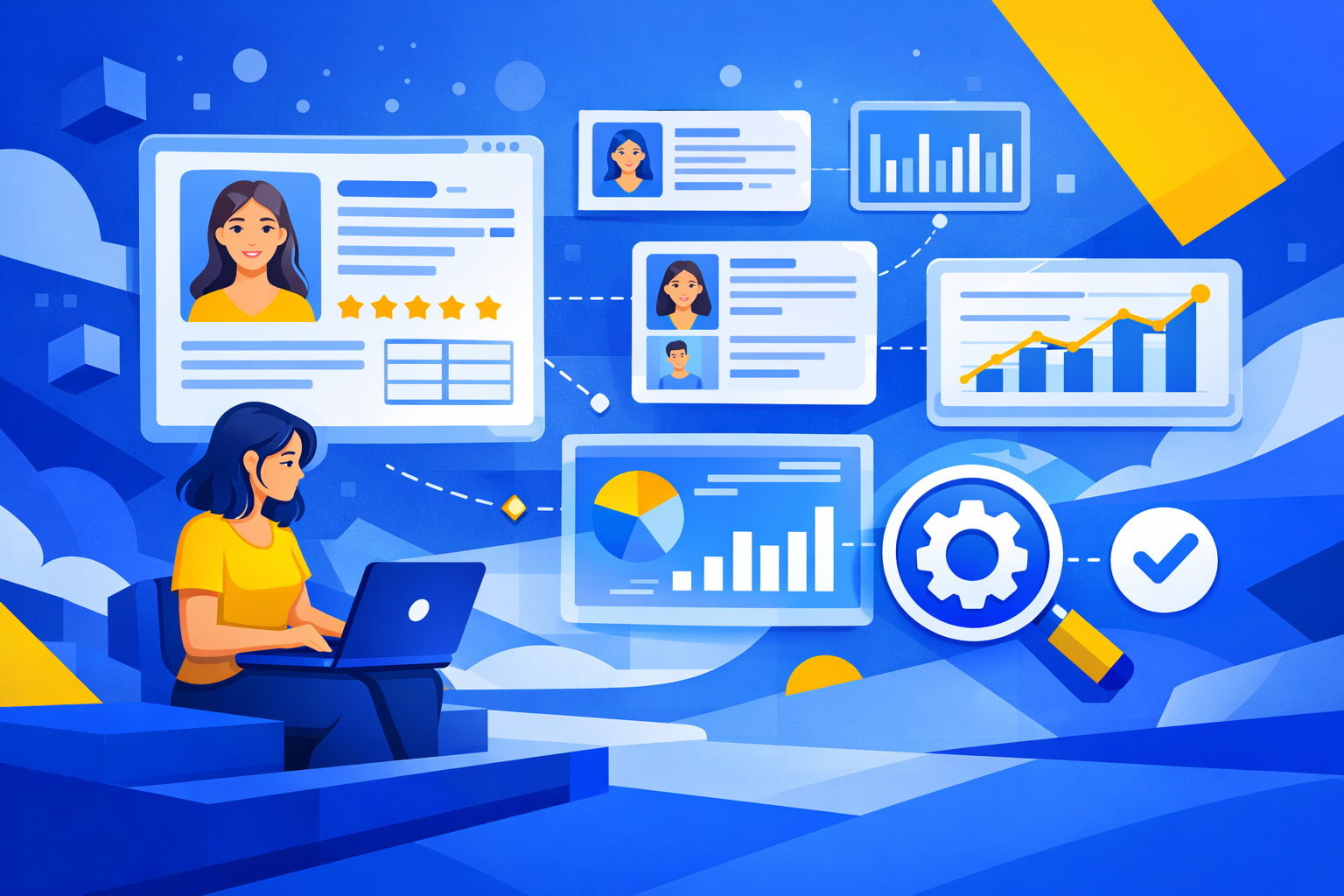
Instead, the platform breaks evaluation into transparent, auditable steps. It reads each resume to map the candidate’s actual experience and skills. It reads the job description to understand what the role genuinely requires. Then it compares the two using large language model reasoning, surfacing clear strengths, honest gaps, and specific areas that might be worth exploring in an interview.
But the analysis does not stop at what is written on the page. For every company listed in a candidate’s work history, the Al performs a live Google search to pull in real context about that employer. What does the company actually do? What is their scale, their industry, their reputation? A job title alone rarely tells the full story, and a candidate who built data pipelines at a fast-growing fintech startup brings a different kind of experience than someone with the same title at a large enterprise. The platform accounts for that distinction automatically, enriching each candidate profile with researched context before the comparison to the job requirements is ever made.
Every step is logged. Recruiters and hiring managers can see exactly how the Al reached its conclusions. This matters for consistency, and it matters even more for accountability. When someone asks why a candidate was flagged or moved forward, there is always a real answer.
We think of this as explainable Al in practice. It is not just a technical feature. It is what makes the tool trustworthy enough to actually use in a consequential process.
Addressing Bias Before It Becomes a Problem
Consistency is one of the hardest things to maintain across a large candidate pool, especially when multiple people are involved in evaluation at different stages. Unconscious preferences creep in. Criteria drift. What gets valued in one interview panel is different from what gets valued in another.
We built in AI-powered bias detection checks that flag potential risks and surface inconsistencies across evaluations. The goal was not to check a compliance box. It was to give hiring teams a practical tool for catching patterns they might not notice on their own, before those patterns affect the outcome.
This kind of systematic check is something that is very difficult to do manually at scale, and it is exactly the kind of work where AI adds genuine value without overstepping.
From Screening to Interview in Less Time
Once a candidate clears the initial review stage, the platform uses generative AI to produce role-specific interview questions. These are not generic questions pulled from a template. They are tailored to the specific role requirements and to what the AI observed about the candidate’s background.
The questions come paired with evaluation rubrics, so interviewers have a consistent framework for assessing answers rather than relying entirely on gut feel. The result is less prep time per candidate and more useful signal per conversation.
For hiring teams running multiple interview loops simultaneously, this kind of efficiency compounds quickly.
What This Reflects About How We Build
This platform is a good illustration of how we approach AI as a company. We are not interested in applying AI because it is trendy or because it makes for a good demo. We are interested in it because there are genuinely hard problems, across industries and workflows, where AI can do real work.
In this case, that meant taking on the structural disorder that makes recruiting painful, building evaluation logic that is transparent by design, and making sure the humans running the process stay in control of the parts that actually require judgment.
The best hire still comes from a conversation. We just built something that makes sure the right conversations happen faster.
The same thinking applies to how we approach software development more broadly. We stay close to what AI can and cannot do well. We build systems that surface reasoning rather than hide it. And we design for the people who will use the tools, not just for the impressiveness of the underlying technology.
The Bigger Picture
We are at a moment in software development where AI is moving from a novelty to an expectation. Clients and users increasingly want to know not just whether AI is involved, but how it is being used, what it is deciding, and what safeguards exist around it.
The recruiting platform we built is one answer to those questions. It shows what thoughtful AI integration looks like when the goal is genuine usefulness rather than surface-level automation. It is explainable, auditable, and designed to support human decision-making rather than replace it.
That is the standard we hold ourselves to, and it is the standard we bring to every product we build.
Interested in what AI-powered software could look like for your team? Let’s talk about what we can build together.